Fee-for-Service Workshops
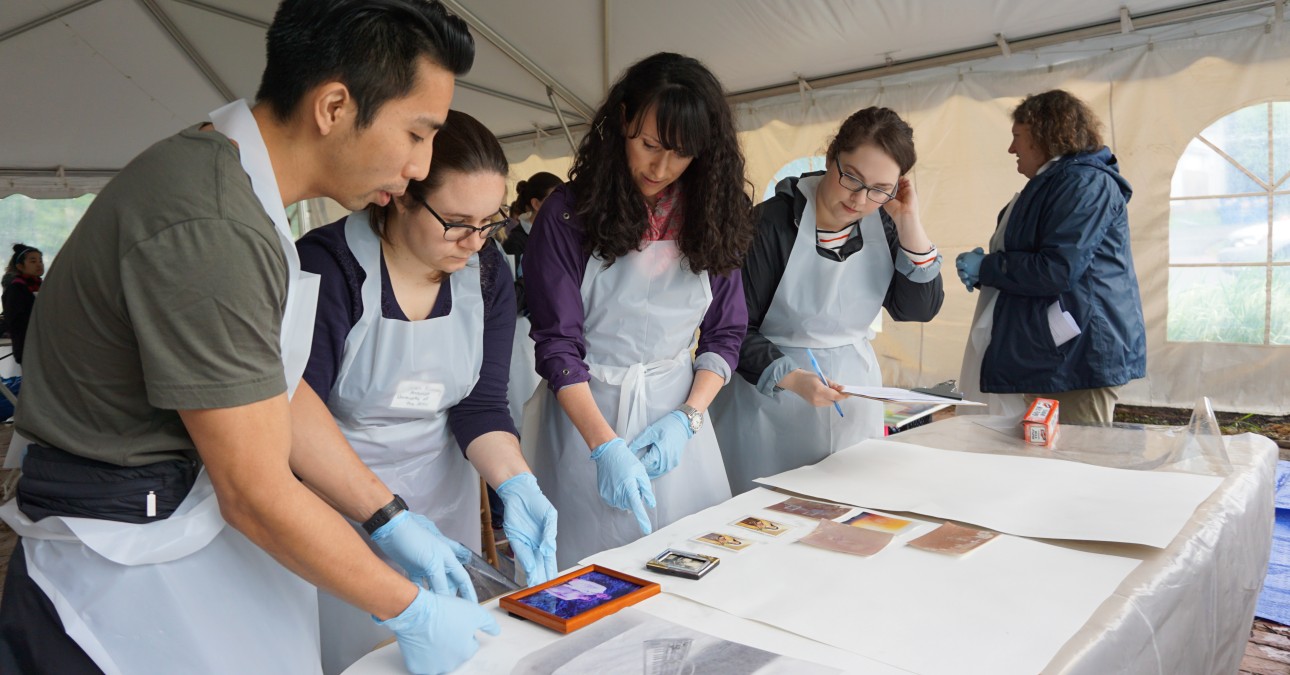
We develop and present lectures, multi-day seminars, hands-on workshops, and pop-up experiences by request for institutions looking to augment the skills of their staff. The sessions listed below are intended primarily for collections managers, archivists, librarians, or other community volunteers who have responsibility for stewardship and preservation of art and artifacts. In some cases, the sessions can be adapted to a one-hour webinar, a virtual meeting with synchronous activity, an in-person experience, or a combination of these formats.
Interested in scheduling a workshop for your institution? Email Education Programs Manager Greg Stuart to get started.
Learn more about working with us on a fee-for-service workshop here.
Assessing Condition Issues in Book Collections
Identifying collection materials with condition issues is a key component to keeping bound collections safe, accessible, and in good condition; and knowing how to prioritize concerns determines how to best allocate resources. Through lecture and hands-on activities, this half-day workshop will help you identify, understand, and prioritize condition issues for your book collection.
Additional topics for discussion include book structure, agents of deterioration, common degradation, and methods for assessing and prioritizing condition challenges.
Book Cradles for Reading Rooms and Exhibitions
The repeated opening of rare and fragile books without supports can cause structural deterioration and textual loss. This half-day workshop will provide you with an overview of the types of book cradles for reading rooms and exhibit cases, focusing on the most useful features of each. Additionally, attendees will take part in a hands-on demonstration showing them how to construct a simple, inexpensive custom book cradle, after which they will have the opportunity to make their own.
Disaster Response and Recovery: A Hands-on Intensive
Thoughtful preparation for an emergency or disaster is one of the most important steps that a cultural institution can take to safeguard collections. This two-part, hands-on program will increase attendees’ practical knowledge through hands-on salvage of a simulated disaster. During this workshop, participants will learn to use the Incident Command System while learning to salvage a variety of materials, including paintings, wooden furniture, glass/metal/ceramic objects, textiles, paper, photographs, and books.
Attendees, in collaboration with instructors, will address personal safety, initial site assessment, object triage and tracking, and post-disaster debriefing. Lastly, participants will strategize on how to strengthen connections between cultural institutions and regional emergency management agencies by working and learning together.
Note: knowledge of basic salvage techniques and/or prior attendance in a collections-oriented emergency response workshop is encouraged. Full cost breakdown available upon request.
Environmental Management
Creating stable environmental conditions is the most significant step an institution can take for the long-term preservation of the collections materials under its stewardship. In this workshop attendees will learn about collections environments, and how to manage conditions to be appropriate for the long-term preservation of artifacts. Instructor also discuss temperature, relative humidity, light, pests, mold, and housekeeping, and discuss how these can impact collections care.
Essential Policies and Procedures for Cultural Institutions
An institution’s collections care and business practices are defined by its written policies and procedures. Institutional memory is often lost through staff changes, but best practices are encoded in these important documents. This workshop will provide you with an overview of policy and planning documents that are essential for collections care, such as collections management policies, handling guidelines, and maintenance policies. You will learn the critical components of these documents and discuss tangible examples of how to adapt them to different institutions. You will also gain knowledge in policy development, approval, and implementation responsibilities of staff, volunteer, and board members.
Forget the Best: Good and Better Approaches to Collections Care
Collecting institutions everywhere strive to meet professional "best practices" when it comes to preserving items in their collections. But for institutions with limited resources for preservation, achieving "best" can often feel impossible. This webinar focuses on how institutions can forgo the “best” in favor of “good” and “better” approaches to preservation, highlighting practical ways to make preservation a component of any collections care program – even one with little to no dedicated resources. Attendees will come away with common, feasible recommendations in areas of collections care, environment, policies, security, emergency preparedness, and more.
Fundamentals of Caring for Paper Collections
This workshop will give attendees an introduction to best practices in caring for any paper-based collection. Topics covered include handling guidelines, assessing storage materials and special needs items, prioritizing for treatment, and understanding preservation and conservation terminology.
This program is appropriate for those looking to develop new skills, as well as for individuals wanting to increase their knowledge about best practices in the care of paper-based collections.
Note: Can be offered in tandem with Housing Solutions.
Handlin’ It: Techniques and Materials for Artifact Packing and Transport
This workshop will address the safe handling and soft packing of flat and three dimensional objects. In this workshop, attendees will learn how to prepare work areas, best practices for moving various types of artifacts, and identifying potential conservation concerns before handling. Additionally, participants will be introduced to materials useful for day-to-day art handling and get hands-on experience packing items for short-term transport.
Housing Solutions
Practical knowledge of preservation materials and housing design is necessary to protect collection items. In this workshop, we will address concerns in creating safe and effective housings for the storage and display of paper art and artifacts. The instructor will additionally discuss materials, use, and benefits of various types of housing, from simple folders and polyester sleeves to oversized rolled storage and framing. Attendees will have the opportunity to create several simple enclosures.
Note: Can be offered in tandem with Fundamentals of Caring for Paper Collections.
Integrated Pest Management
Identifying particular pest species and the risks they pose to collections is an essential component in protecting environments and detecting materials damage. This program offers recommendations for developing an integrated pest management plan in museums, galleries, libraries, and archives. Additionally, the instructor will provide information on addressing pest identification, monitoring, and eradication treatments.
Note: Can be offered in tandem with Mold: Prevention, Detection, and Response
Internal Advocacy for Collections Care
Advocacy is not only external – it is crucial for staff at institutions to be able to advocate internally as well, to board and administration, in order to assure that resources are best allocated. In this workshop, attendees will explore routes for internal advocacy with a focus on collections care, and securing time and funding for preservation initiatives and conservation treatment. The instructor and attendees will discuss opportunities for incorporating information about preservation into all institutional advocacy efforts.
This webinar will also include practical tips and examples of initiatives that have successfully incorporated both collections care and advocacy efforts at museums, libraries, and archives.
Introduction to Digitization
Digitization can be the final step in processing collections, facilitating access, and even aiding in collections’ long-term preservation. Like other collections care endeavors, digitization should not be undertaken without an understanding of best practices, safe techniques, and the knowledge to make the right decisions. This workshop will provide attendees with a basic overview of some of the considerations institutions should make when digitizing materials establishing policies, prioritization and selection criteria, equipment options, handling practices while scanning or photographing, storage concerns for digital media, and digital preservation.
This digitization program is intended for collections staff and volunteers relatively new to digitizing materials, as well as those who would like a refresher.
Matting and Framing for Preservation
This workshop will serve as an introduction to the materials and techniques necessary for creating safe and attractive housing and framing for works on paper. In this program, attendees will learn basic principles of framing and housing. Participants will gain a greater understanding of techniques, assembly methods, materials, and common mistakes.
The session will have a hands-on component covering the construction of archival corners and edge supports, hinges, and sink mats for objects with depth.
Mold: Prevention, Detection, and Response
Mold spores are always present, even in the cleanest of spaces. When too much moisture is present, due to a water leak or a poorly functioning HVAC system, mold outbreaks can occur. As it grows, mold attacks and weakens leather, cloth, and paper, and often causes permanent staining. Some molds also make people sick. How can you stop mold from growing? And what should you do when they find it? This workshop will answer these questions by explaining the environmental factors that allow mold to grow. The instructor will discuss how to identify mold, how to protect people from health hazards associated with mold, and how to stop mold from spreading within a collection. Participants will learn how to clean moldy books and papers, and when to call a conservator or a professional cleaning company.
Note: Can be offered in tandem with Integrated Pest Management
Preservation Fundamentals
Archivists, collections managers, librarians, curators, and other staff members involved in collections care must manage a variety of tasks, including implementation of collections management plans and policies, management of environmental control and storage conditions, and provision for safe use and exhibition of collections. This program will provide attendees with an overview of the preservation standards for the many aspects of collections care.
Preservation Planning
A Preservation Plan is an essential institutional document that helps collections care professionals thoughtfully and carefully chart a course for the preservation of their artifacts for five to ten years. Without planning, it can be nearly impossible to effectively budget for staff time and resources, and the care of priceless collections often suffers. In this webinar, attendees will receive guidance on how to create a Preservation Plan. Additionally, participants will have the opportunity to explore sample Plans as well as practice creating goals, objectives, and strategies to make an effective Plan.
Preserving Your Photographic Collections
Photographic media are sensitive materials that require special housing to ensure their longevity. In this workshop, attendees will learn about suitable housing supplies, including paper, plastics, interleaving papers, boxes, and more for your photo-based collections. Participants will also learn environmental parameters for storage, proper labeling techniques, and safe handling of photographs.
Red Flag! Identifying Preservation Needs While Processing Collections
Gaining intellectual control over collections is just one aspect of processing and cataloging. This workshop will focus on developing a system for identifying and prioritizing the collections care needs of items (objects, books, artworks, archival materials, etc.) during the accessioning, processing, and cataloging phases. The instructor will discuss common degradation issues encountered in collections and provide methods for assessing condition. Attendees will learn procedures for assigning conservation and housing priorities, and will have the opportunity to assess the condition of items in a study collection and assign conservation and housing priorities to each item using the procedures presented in the workshop.
Risk Assessments and Emergency Preparedness for Cultural Institutions
One of the most important steps any cultural institution can take to safeguard collections is to be prepared in the event of an emergency or disaster. This webinar will provide attendees with a “big picture” overview of emergency planning and preparedness. Participants will learn the terminology of emergency planning, the basic components of an emergency preparedness and response plan, and the importance of risk assessment.
Social Media for Collecting Institutions
Through social media, your institution can build audiences, share stories, promote events, and raise money. Facebook, Instagram, blogs, and crowdfunding platforms like Indiegogo and Kickstarter allow you to connect with new audiences in fresh and vital ways. This session will give organizations tools to understand the wide range of emerging social media opportunities to position institutions and their collections in the 21st century.
Understanding Archives: An Introduction to Archival Basics
Proper archival procedures enable safe and effective management of collections, yet as often is the case in many institutions, you may find yourself in the position of "archivist" without formal training in the profession. This workshop is designed to equip attendees with the fundamentals of archival appraisal, acquisition, and access; proper storage materials; and an understanding of the most common preservation problems found with paper-based archival collections. The instructor will touch briefly on processing, arrangement, and description of collection objects.